CVLander research · September 2026
September 2026 job market: inside 6,642 CVLander listings.
Where you look for work changes the opportunities you see. We analysed 6,642 active listing records across nine CVLander sources to examine remote and hybrid labels, employer concentration and the information available to applicants. This report describes our selected feeds as of 29 September 2026—not the whole job market or every vacancy posted during September.
By CVLander · Prepared · 14 min read
Research edition 01
Selected feeds and configured employer boards · Data as of 29 September 2026, 21:07 UTC
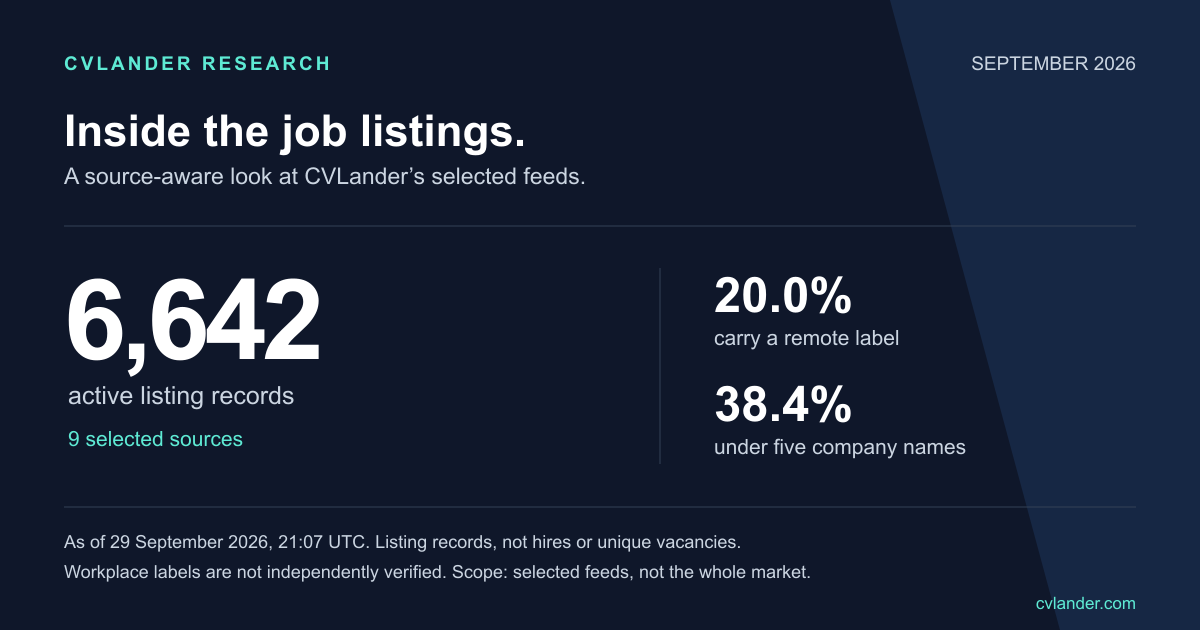
- Active listing records
- 6,642
- Carry a remote label
- 20.0%
- Under five company names
- 38.4%
9 sources. Listing counts, not hires or unique vacancies. Workplace labels are not independently verified. Read the methodology.
In brief
- Remote depends on the feed. 1,330 listings (20.0%) carry a remote label. Three remote-focused feeds provide 67.8% of those records, so this share reflects our source selection as well as the listings themselves.
- Large company boards shape the results. The five largest company labels account for 2,548 records (38.4%). A listing-weighted picture is not the same as a picture of the typical employer.
- Missing fields need careful interpretation. 60.3% have no seniority label. Salary data is present in 16.1%, but importer coverage prevents us from treating the remainder as employers withholding pay.
The September picture: breadth, with concentration
At the reporting cut-off, CVLander held 38,459 retained listing records first seen between 21 June and 29 September 2026. Of these, 6,642 were marked active and met a declared seven-day freshness check. The retained archive and the active board answer different questions: the first describes records still stored; the second describes the listings included in this report.
The active records contain 1,058 company labels after trimming and case-folding, compared with 1,067 original company strings. These are names in feeds, not independently verified legal entities. A company can appear under more than one name, and a job record can represent an evergreen advert or a separate requisition with the same title.
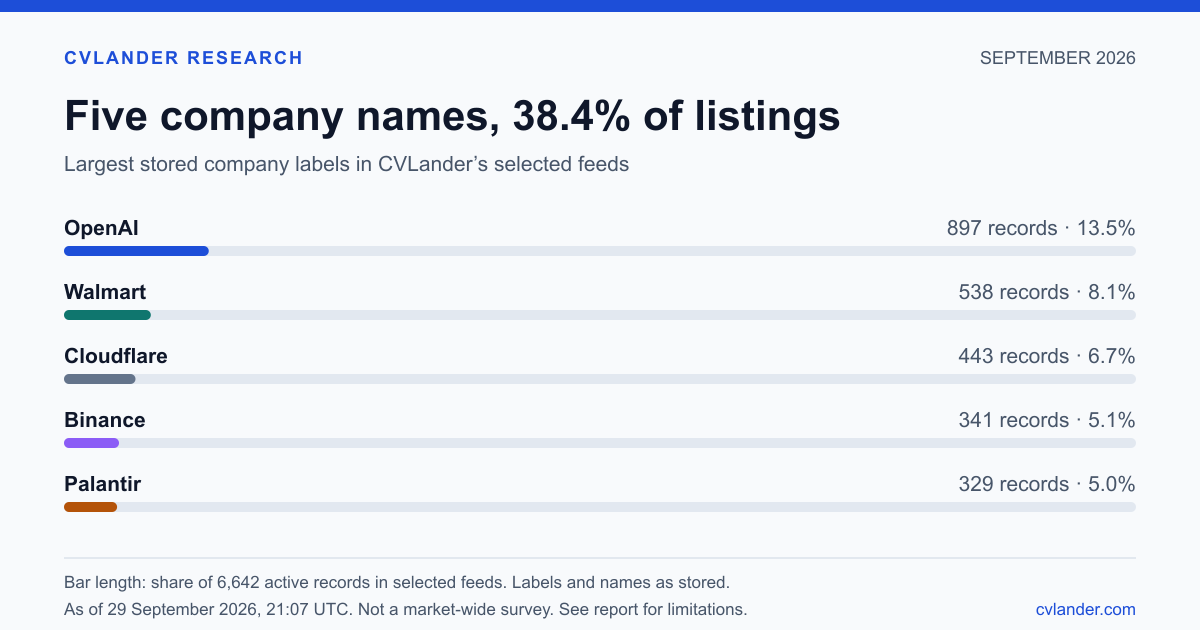
The distribution is concentrated. OpenAI, Walmart, Cloudflare, Binance and Palantir together contribute 2,548 records. The ten largest stored names account for 3,397 (51.1%). This is useful for understanding the board, but it is not a ranking of which employers are hiring the most people.
For applicants, the implication is practical: a long results list can still be dominated by a few employer boards. Search across several organisations and inspect the vacancy itself rather than treating listing volume as a measure of your chances.
Five company names, 38.4% of listings
Largest stored company labels in CVLander’s selected feeds
- OpenAI: 897 records, 13.5%
- Walmart: 538 records, 8.1%
- Cloudflare: 443 records, 6.7%
- Binance: 341 records, 5.1%
- Palantir: 329 records, 5.0%
Share of all 6,642 active listing records, not hires, unique vacancies or the wider labour market. Bar length shows share of all active records. Data cut-off: 29 September 2026, 21:07 UTC.
Download this chart (SVG)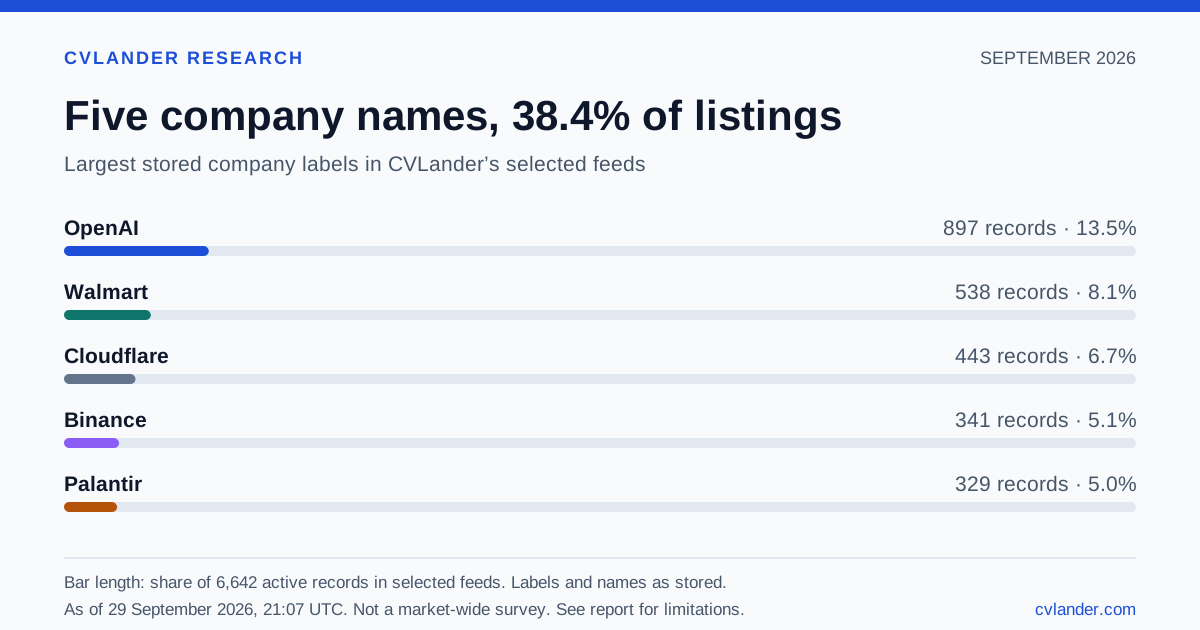
| Company label | Records | Share of active records |
|---|---|---|
| OpenAI | 897 | 13.5% |
| Walmart | 538 | 8.1% |
| Cloudflare | 443 | 6.7% |
| Binance | 341 | 5.1% |
| Palantir | 329 | 5.0% |
| Wayve | 207 | 3.1% |
| ClickHouse | 178 | 2.7% |
| Ramp | 173 | 2.6% |
| Cohere | 150 | 2.3% |
| Octopus Energy | 141 | 2.1% |
Company labels are preserved for this ranking. No corporate-family or legal-entity consolidation is applied.
Remote and hybrid work: read the labels, then the conditions
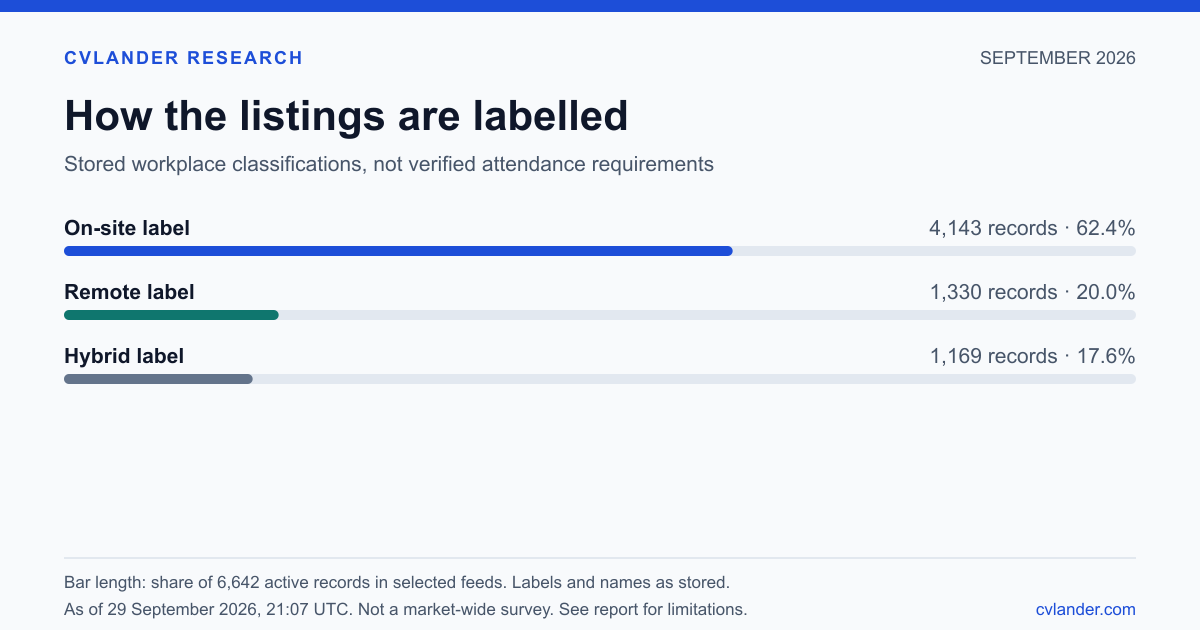
The stored classifications split into 1,330 remote-labelled records (20.0%), 1,169 hybrid-labelled records (17.6%) and 4,143 on-site-labelled records (62.4%). These are classifications recorded by the import pipeline, not an independent audit of attendance requirements.
Several importers infer a workplace type from location text and use on-site when no recognised remote or hybrid signal is found. That fallback means the on-site total can include incomplete or ambiguous information. It would be misleading to turn it into a claim that 62.4% of employers require office attendance.
The remote-focused Jobicy, RemoteOK and Remotive feeds supply 902 of the 1,330 remote-labelled records (67.8%). A board with a different mix of sources could show a very different remote share without any change in employer demand.
Hybrid labels are concentrated too: 825 are in the Ashby feed and 344 in the Greenhouse feed. The distribution describes what our selected boards expose and what the importers recognise. It cannot establish a return-to-office trend.
A remote label is a starting point for reading, not proof that the role is open worldwide. Check the permitted hiring countries, time-zone overlap, work-authorisation requirements and any travel or office expectations on the employer’s application page.
How the listings are labelled
Stored workplace classifications, not verified attendance requirements
- On-site label: 4,143 records, 62.4%
- Remote label: 1,330 records, 20.0%
- Hybrid label: 1,169 records, 17.6%
All 6,642 active listings. On-site is a fallback in several importers; remote does not mean work from anywhere. Bar length shows share of all active records. Data cut-off: 29 September 2026, 21:07 UTC.
Download this chart (SVG)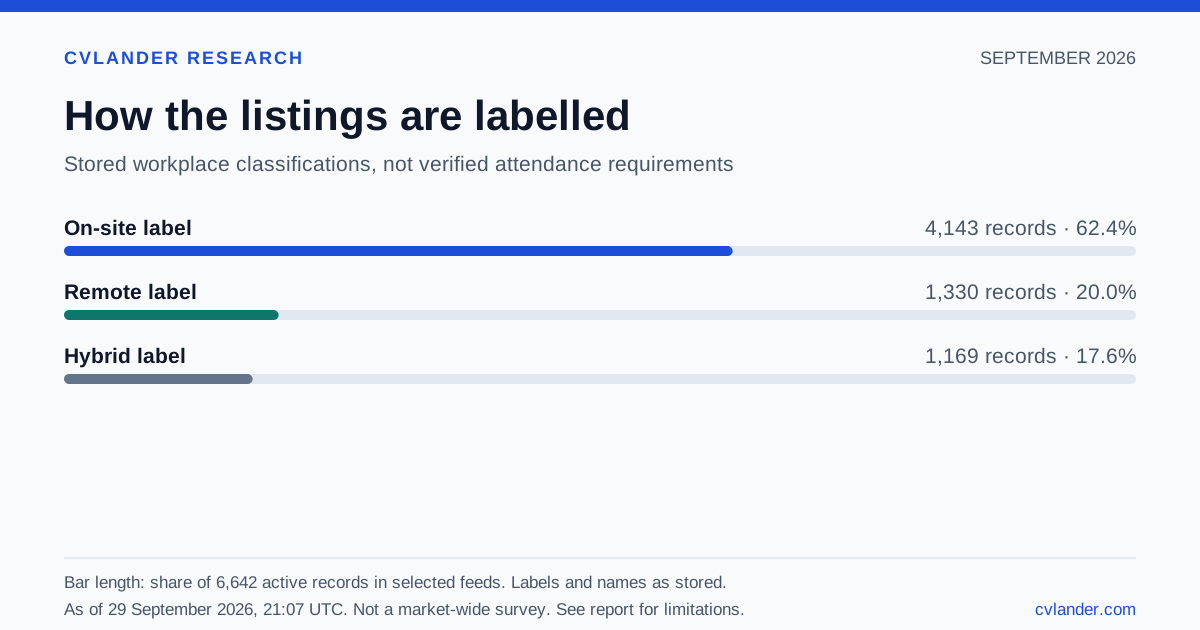
The sources explain much of what you see
Our nine sources combine job feeds with configured employer boards hosted on applicant-tracking platforms. We do not cover every employer using Ashby, Greenhouse, Lever or Recruitee. Likewise, aggregator feeds are limited by the pages, filters and records available to the ingestion process.
The three largest active sources—Ashby, Arbeitnow and TheMuse—supply 4,167 records, or 62.7% of the active total. This mix matters when interpreting every other figure. A remote-focused feed can dominate a workplace subset, while a handful of large employer boards can dominate the company ranking.
The table below keeps the source denominator visible. Remote and hybrid counts are stored classifications. A populated salary field means CVLander imported some compensation text into its structured field; it does not prove that all compensation information in the original advert was captured.
| Source | Active records | Remote label | Hybrid label | Salary field present |
|---|---|---|---|---|
| Ashby | 1,611 | 328 | 825 | 1,045 |
| Arbeitnow | 1,478 | 78 | 0 | 0 |
| TheMuse | 1,078 | 8 | 0 | 0 |
| Lever | 817 | 4 | 0 | 0 |
| Jobicy | 793 | 793 | 0 | 0 |
| Greenhouse | 739 | 6 | 344 | 0 |
| RemoteOK | 94 | 94 | 0 | 16 |
| Recruitee | 17 | 4 | 0 | 0 |
| Remotive | 15 | 15 | 0 | 10 |
Zero means zero populated values in this export, not zero matching opportunities or zero salary disclosures in the source adverts.
Seniority labels leave a large gap
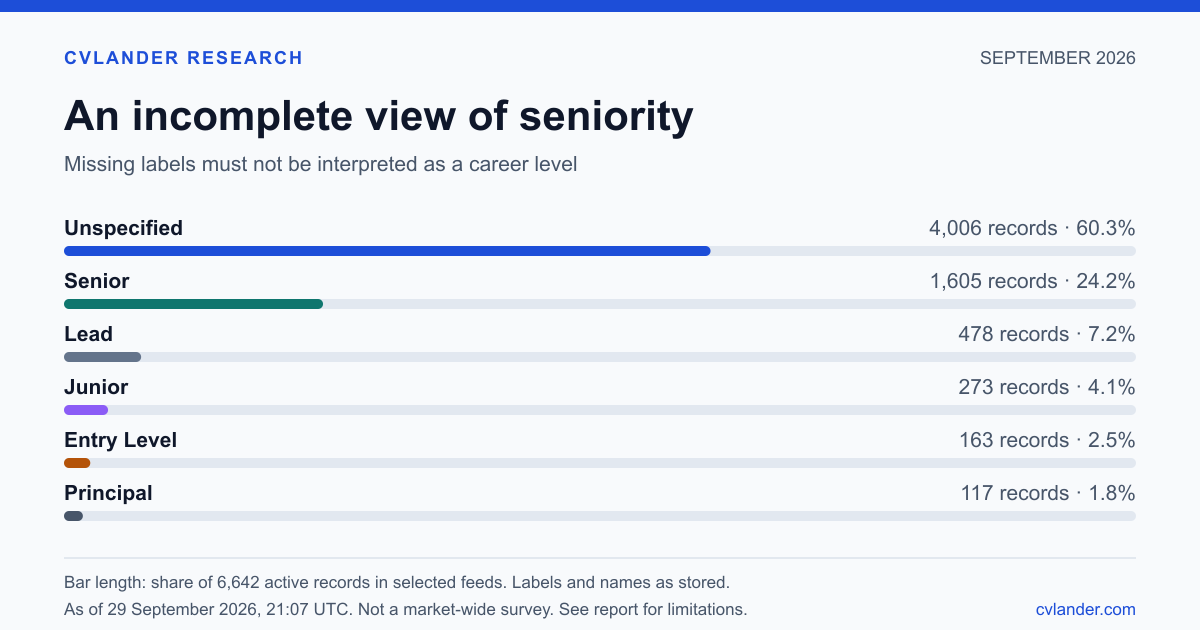
A seniority label is absent from 4,006 active records (60.3%). Among the recorded labels, Senior appears 1,605 times, Lead 478 times, Junior 273 times, Entry Level 163 times and Principal 117 times. These labels are imported or inferred from titles and tags, rather than assigned through a consistent review of every vacancy.
Junior and Entry Level together account for 436 records, or 6.6% of the active board. That is the share carrying those labels—not the share of vacancies that could suit someone early in their career. The large unspecified group prevents a sound claim about entry-level scarcity.
When searching, combine level filters with relevant role titles and read the requirements. A graduate programme, assistant role or associate position may not carry a junior label; an associate title may also mean different things in different sectors. Look for the actual experience, qualification and responsibility requirements rather than assuming the title settles the question.
An incomplete view of seniority
Missing labels must not be interpreted as a career level
- Unspecified: 4,006 records, 60.3%
- Senior: 1,605 records, 24.2%
- Lead: 478 records, 7.2%
- Junior: 273 records, 4.1%
- Entry Level: 163 records, 2.5%
- Principal: 117 records, 1.8%
All 6,642 active listings. Labels are imported or inferred; an unspecified level is not automatically mid-level. Bar length shows share of all active records. Data cut-off: 29 September 2026, 21:07 UTC.
Download this chart (SVG)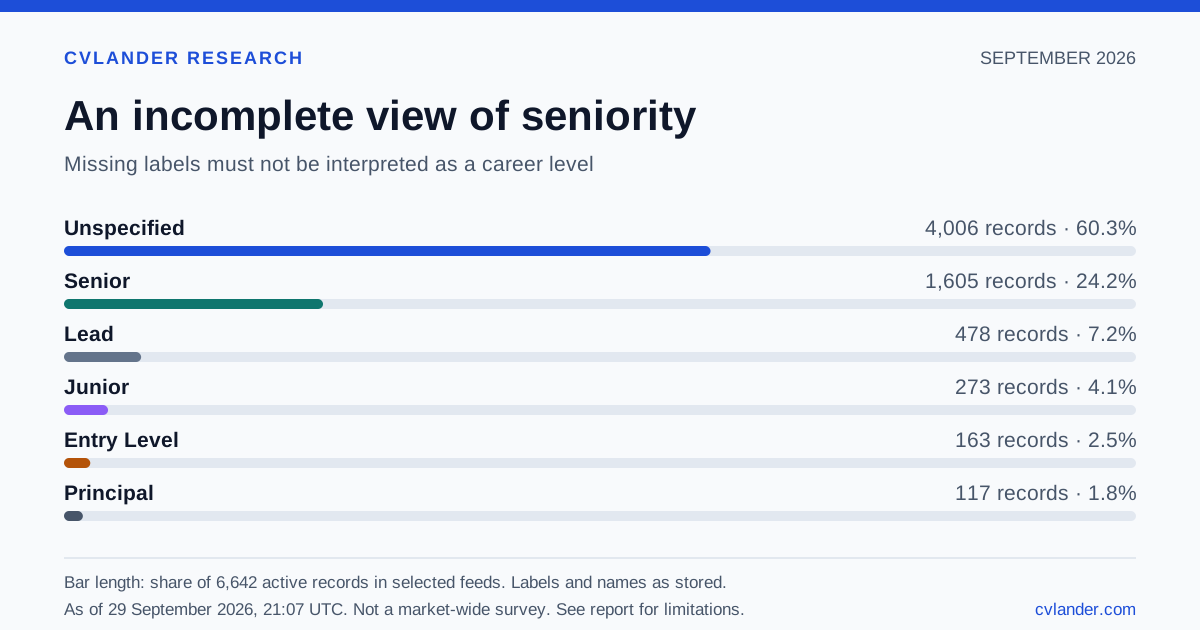
Salary and geography: what this export cannot tell us
The structured salary field is populated for 1,071 active records (16.1%). Of those, 1,045 come from Ashby, 16 from RemoteOK and 10 from Remotive. Six other source adapters do not populate that field. Its completeness therefore measures the pipeline as well as the source material.
This is not evidence that the remaining employers hide pay. Compensation may appear in an advert’s body or in another source field that the importer does not capture. We do not calculate average salaries, compare employer pay transparency or turn blank values into zero pay.
Country data has a similar limit. The field is blank in 3,162 active records (47.6%), and some populated values represent remote arrangements or regions rather than countries. A country label can also simplify a multi-location vacancy. We therefore do not publish a country league table or use these values to establish applicant eligibility.
Before investing in an application, verify salary currency and pay period, base versus variable compensation, location restrictions and the actual employing arrangement. Treat missing structured fields as a reason to check the original listing—not as a negative conclusion about the employer.
| Field measure | Records | Share | What it means |
|---|---|---|---|
| Salary field populated | 1,071 | 16.1% | Some structured compensation text was imported |
| Country field blank | 3,162 | 47.6% | No country value is stored |
| Seniority field blank | 4,006 | 60.3% | No career level is stored |
Coverage is not the same as accuracy. Populated fields can still be inferred, incomplete or unsuitable for a market-wide comparison.
Why the archive does not prove a hiring boom
We have several months of retained records, but we do not have comparable month-end snapshots of the board. The counts below group currently retained records by when CVLander first ingested them. They are not monthly vacancy totals, employer posting counts or net changes in the job market.
Feed coverage changed during the period. For example, Ashby records first appear in the retained data in August; Greenhouse, Lever and Recruitee first appear in July. Arbeitnow contributes 12,693 of the 15,680 retained records first seen in September. These changes are enough to make a simple month-to-month growth chart misleading.
The database also stores current values rather than a full history of each listing. Refreshes can overwrite posting dates, labels and other fields. Some source adapters use an update date or a fallback time as the posting date. Records removed entirely are absent from this export.
To measure future changes, a recurring report needs immutable observations, a stable comparison panel of sources and employer boards, and a record of changes in feed coverage. Until that exists, this edition establishes a dated baseline. It does not declare the market to be recovering, slowing or expanding.
| First-seen month | Retained records | Coverage note |
|---|---|---|
| June 2026 | 2,016 | Coverage begins 21 June |
| July 2026 | 6,103 | Additional board types appear |
| August 2026 | 14,660 | Ashby first appears |
| September 2026 | 15,680 | Export ends 29 September |
June and September are partial periods. The population is records retained at export, not all records ever observed.
Which words appear in job titles?
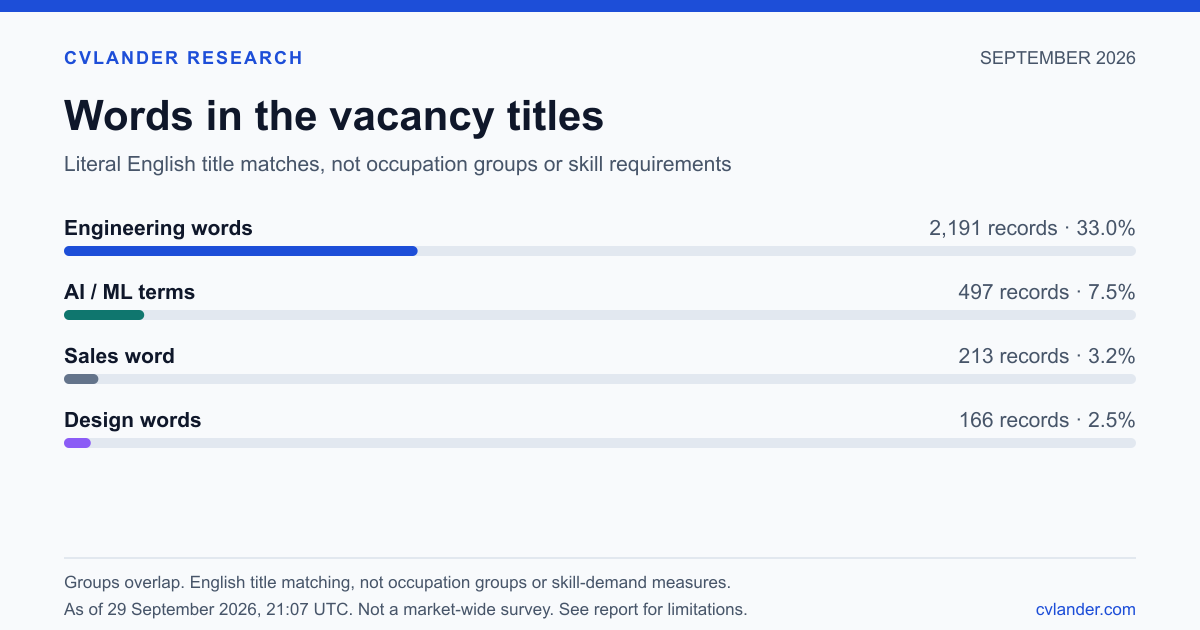
Engineering-related words appear in 2,191 of the 6,642 analysed titles (33.0%). AI or machine-learning terms appear in 497 (7.5%). These are literal title-word matches: they describe useful search signals in our tracked listings, not a complete occupation classification or a measure of demand for particular skills.
For the engineering rule, we match the whole words engineer, engineers or engineering. For AI / ML, we match AI, ML, artificial intelligence, machine learning, deep learning or LLM. The search is case-insensitive and uses the vacancy title only; a company name such as OpenAI does not make a role an AI match.
The groups overlap. In particular, 307 titles match both the engineering and AI / ML rules, so their totals must not be added together. The same title can contain sales and engineer, or design and engineering. These words do not prove what the person will do or which technologies the employer requires.
For a remote-focused search, 441 of the 1,330 remote-labelled records match the engineering rule (33.2% of that subset), and 79 match AI / ML (5.9%). These are within-subset shares, not the probability that an engineering or AI role is remote.
Use the words as additional searches, then inspect the responsibilities. The method misses synonyms and untranslated titles: a sales-word search will miss some Account Executive titles, for example. Engineering can also appear in a management or recruiting title. The concentration of our employer boards still shapes the results.
Words in the vacancy titles
Literal English title matches, not occupation groups or skill requirements
- Engineering words: 2,191 records, 33.0%
- AI / ML terms: 497 records, 7.5%
- Sales word: 213 records, 3.2%
- Design words: 166 records, 2.5%
All 6,642 active records. Case-insensitive English word matching. Groups overlap and do not cover every role. Bar length shows share of all active records. Data cut-off: 29 September 2026, 21:07 UTC.
Download this chart (SVG)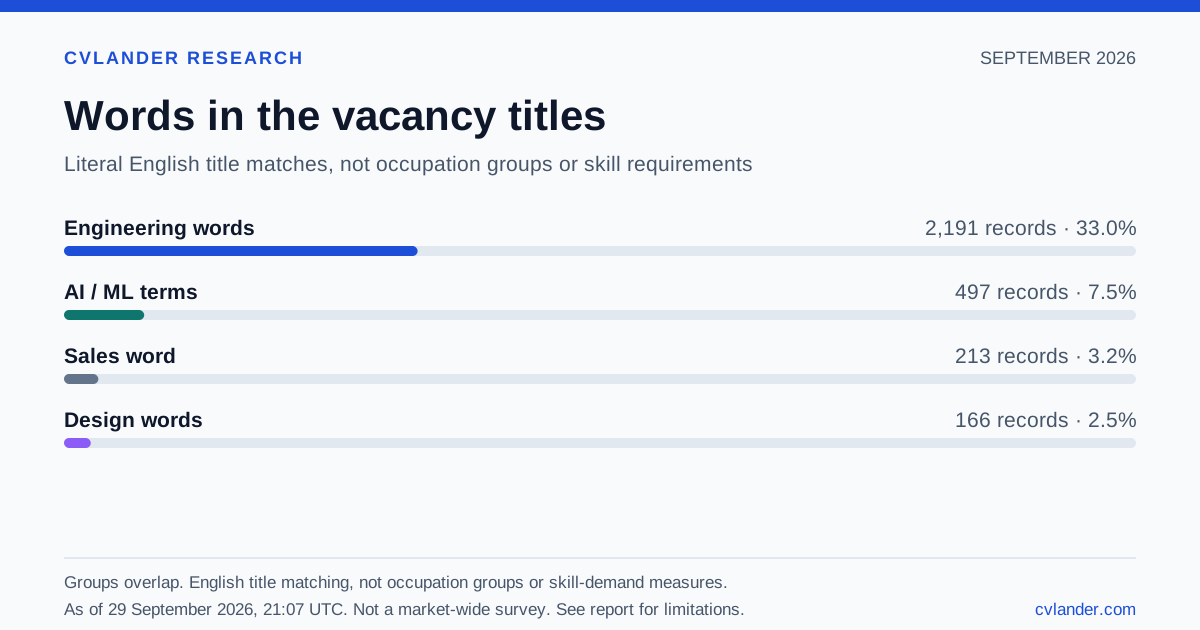
| Literal title signal | Active matches | Share of 6,642 | Remote matches | Share of 1,330 |
|---|---|---|---|---|
| Engineering words | 2,191 | 33.0% | 441 | 33.2% |
| AI / ML terms | 497 | 7.5% | 79 | 5.9% |
| Sales word | 213 | 3.2% | 69 | 5.2% |
| Design words | 166 | 2.5% | 43 | 3.2% |
Groups overlap. Percentages in the last column use remote-labelled records as their denominator, not all records matching that title rule.
A practical way to use the findings
The useful lesson is to make the shortlist more deliberate. This report can help you understand the board’s composition and the limits of its filters; the employer’s live vacancy remains the authority on the role.
- Start with the work you can do. Search relevant titles and responsibilities across several employers, then use workplace and seniority labels to narrow—not define—the search.
- Open the original employer listing. Confirm that applications are still accepted and read the precise location, work-authorisation, time-zone and attendance conditions.
- Check compensation in context. Look for currency, pay period, location-specific ranges and the distinction between base pay and total compensation.
- Check repeated adverts before applying twice. Similar titles and locations can be separate requisitions, but they can also repeat the same opportunity.
- Tailor your resume to the verified requirements. Use evidence from your own experience rather than adding skills or credentials just because they appear in a listing.
Methodology, definitions and checks
CVLander analysed a read-only production export taken on 29 September 2026 at 21:07:21 UTC. The input contains job-listing metadata only. No candidate, resume, application or user records are part of this research. The original export is not published; aggregate tables are available below.
The reporting unit is a stored listing record. The included population is records marked active, last seen within seven days of the export time, and not past an explicit expiry date. Seven days is a declared research assumption matching the default freshness rule, not a claim that production configuration was independently verified. All 6,642 active records satisfy the check, and every expiry field in the export is blank.
All percentages use the 6,642 included records unless another denominator is explicitly stated, and are rounded to one decimal place. Company breadth uses trimmed, case-folded labels; rankings preserve stored company names without corporate-family matching. Workplace, seniority and employment-type labels are retained as recorded rather than independently reassigned.
We checked the CSV structure and listing identities. There are no duplicate IDs, slugs or source/external-ID pairs. However, 43 active company/title/location groups contain 53 additional records with different identities. These may be different requisitions, so we retain them and do not claim to count unique vacancies. Collapsing every such exact-match group would leave 6,589 records; this sensitivity check is not a verified deduplication result.
Active means recently observed and included by the stated rule, not independently confirmed open by contacting every employer. An old posting date is not enough to declare a role obsolete, and an inactive retained record is not proof a position was filled. There is no applicant count, hire count, representative sampling frame or common salary measure in this export.
The figures were cross-checked using two separate calculation implementations: Python’s CSV reader and pandas. A versioned deterministic analysis script reproduces the released aggregates from the private input. This report describes selected feeds and configured employer boards at one cut-off; it does not estimate unemployment, economy-wide demand, skill shortages or hiring growth.
Research baseline
A clear starting point for the next edition
This edition establishes what our tracked listings looked like at the September cut-off. A future trend report will need comparable saved observations and explicit source-coverage controls. We will not treat changes in the size of our feeds as changes in the wider job market.
Reading this report responsibly
- Do not describe these findings as national or global job-market statistics.
- Do not equate stored workplace or seniority labels with independently verified employer requirements.
- Do not interpret missing salary fields as employers withholding pay, or missing seniority as mid-level work.
- Do not describe retained first-seen cohorts as monthly hiring growth, or listing records as hires or unique vacancies.
Download, cite and share
These aggregate tables and CVLander-created graphics are available for editorial reuse. Keep the date, selected-feed scope and relevant caveats with any excerpt. The private export and individual listing records are not included.
- Aggregate tables (CSV)
- Aggregate evidence (JSON)
- Report graphic (PNG)
- Workplace labels chart (PNG)
- Company concentration chart (PNG)
- Seniority labels chart (PNG)
- Title-word signals chart (PNG)
Suggested citation: CVLander. “September 2026 job market: inside 6,642 CVLander listings.” Data as of 29 September 2026, 21:07 UTC. Selected feeds and configured employer boards, 6,642 active listing records. Methodology and limitations.
Have a question or correction? Contact CVLander.
Frequently asked questions
What does the September 2026 job market report cover?
It covers 6,642 active CVLander listing records from nine selected sources as of 29 September 2026, 21:07 UTC. It is not a representative survey of a country or of the global job market, and it does not count every vacancy posted during September.
What share of the tracked listings is remote?
1,330 of the 6,642 included records carry a remote classification, or 20.0%. This is a stored label, not an independent verification of workplace rules. A remote role can still restrict hiring countries, time zones or work authorisation.
Does the report show that hiring increased during September?
No. The retained archive contains several months of first-ingestion dates, but source coverage changed and current records do not preserve comparable historical states. Those counts cannot establish month-to-month market growth.
Can I cite the findings or use the charts?
Yes. The aggregate data and chart downloads below are provided for editorial reuse. Keep the cut-off date, the selected-feed scope and the classification caveats with the finding, and cite this report as the original analysis.
Sources and further reading
Primary evidence: CVLander’s read-only listing export, cut off 29 September 2026. The links below describe source interfaces and services; they do not independently validate this report’s figures.
Find a role worth a focused application
Browse the current board, verify the vacancy on the employer’s site, then tailor your resume to the requirements you can genuinely meet.